
New Glasgow, Nova Scotia, Friday, March 20,...
Music Therapy at Aberdeen Hospital
New Glasgow, Nova Scotia, Thursday, March 19, 2026, …. Heather Cameron grew up in Pictou County surrounded by music. She began playing at just four years old and always knew music would be part of her life. But it wasn’t until the fourth year of her university degree, while researching music and well-being for a psychology paper, that she first encountered the term ‘music therapy’.
“I remember thinking in that moment, that’s exactly what I’m going to do.”
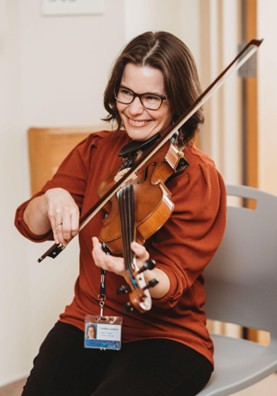
Photo Caption: Music therapist Heather Cameron leads a group session at Aberdeen Hospital. The music therapy program is funded by Aberdeen Health Foundation, supporting patients and families as part of whole-person care.
Today, Heather provides music therapy both at Aberdeen Hospital and in the community. Her visits may involve a one-on-one session with a single patient, or a gathering of family members sharing music together in a hospital room or living room. Each session is shaped around the individual.
“It’s never just a song,” explains Heather. “It’s about the relationship between the therapist, the person, and the music. Music can connect to so many parts of being human: emotional, spiritual, cognitive, social, and physical. It meets people where they are.”
The music therapy program at Aberdeen Hospital began as part of the palliative care program, supported by the Aberdeen Health Foundation. It was originally launched as a three-year pilot project funded by several community partners, including the Aberdeen Hospital Auxiliary, Aberdeen Palliative Care Society, the Pictou County Prostate Cancer Support Association, and the Aberdeen Health Foundation. After the pilot demonstrated strong impacts for patients and families, Nova Scotia Health made the music therapist position permanent. Former palliative care physician Dr. Anne Kwasnik remembers how quickly people began to recognize its value.
“It started as part of the palliative care program and then evolved into a hospital-wide program because people recognized the effectiveness,” she says. “Music therapy can sometimes do more in a short session than months of traditional therapy.”
The program became especially important during the isolation of the COVID-19 pandemic.
“It was a crazy time. People were often alone,” says Dr. Kwasnik. “The music therapist could bridge that gap somehow. Music helped people communicate, be comforted, and even leave something meaningful behind.”
One way this happens is through something Heather calls a ‘Heart Song’. Using a specially adapted stethoscope recorder, she can capture a patient’s heartbeat and weave it into a piece of music for families to keep.
“You managed to pivot to the needs of the day, bringing joy and a vehicle for expression through music,” one family member wrote in a thank you note. “You thoughtfully and intentionally built an experience which became a highlight of each week in her illness… to transport all of us into that temporary world where illness wasn’t uppermost gave relief.”
Heather’s connection to Aberdeen Hospital goes further than her work today. Her mother was a nurse at the hospital for more than 40 years.
“There’s a photo of my mother and me when I was young, taken while she was working at the hospital,” Heather says. “That photo is grounding for me. It reminds me how connected my life has been to this hospital and to this community.”
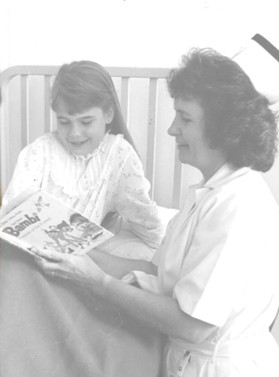
Photo Caption: Heather (left) is shown modeling a new crib purchased for the Women and Children’s unit, an investment made possible through community support of the hospital in the earliest days of the Aberdeen Health Foundation. Heather’s mother, Dorothy Cameron (right), was a nurse at Aberdeen Hospital for more than 40 years.
That connection feels especially fitting in 2026, as the Aberdeen Health Foundation marks its 40th anniversary supporting health care in Pictou County. Programs like music therapy exist because of that community support. Today, the Foundation continues to support the program by funding specialized equipment and supplies that help the music therapist deliver sessions for patients and families.
“As a profession, music therapy is still relatively new,” Heather explains. “There are only about a dozen certified music therapists practicing in Nova Scotia Health right now. Having this role funded and supported means everything. It allows this kind of care to exist and grow.”
Looking ahead, Heather hopes to see the role of creative arts in health care continue to expand.
“My hope is that someday we’ll have a full creative arts therapy department. Music, art, drama, movement – all working together to support patients.”
——————————————
The Aberdeen Health Foundation is the leading charity for enhancing health care in Pictou County. In 2025, the Foundation invested over $3 million to fund medical equipment and enhance health programs at the Aberdeen Hospital and in the community. Your contribution can be the catalyst for even greater change — find out how you can make an impact here.